
Rubber tracks work under repeated load, bending, impact, and contact with uneven ground. Their performance depends on more than rubber formulation alone. During curing, pressure influences how the rubber fills the mould, bonds with internal components, and maintains the required shape. For manufacturers, pressure control is becoming a more important part of process consistency.
In the rubber track manufacturing process, small changes in curing conditions can affect dimensional stability, surface quality, bonding, and repeatability. Production teams increasingly monitor pressure together with temperature, curing time, mould condition, and material preparation. Better control does not mean using higher pressure. It means applying suitable pressure in a stable and repeatable way.
Why Pressure Stability Matters During Curing
Vulcanization changes uncured rubber into a more stable elastic structure. Pressure helps keep the compound in close contact with the mould surface and internal reinforcement during this stage. If pressure is unstable, material flow may become uneven. This can create variation between tracks produced in different cycles, even when the same rubber compound is used.
Pressure also affects how well rubber fills detailed mould areas. Large tread blocks, edges, and embedded structures may require consistent force throughout curing. When pressure drops too early or changes sharply, the finished part may show local defects or dimensional differences that complicate inspection.
Production teams therefore need to treat pressure as part of the complete curing window. Temperature and time still matter, but they should not be reviewed separately. A stable rubber track vulcanizing machine should support repeatable pressure control so operators can compare cycles and adjust process settings with clearer reference points.
Process Control Starts Before the Press Closes
Pressure problems are not always caused by vulcanizing equipment. Compound weight, preform shape, placement accuracy, mould cleanliness, and reinforcement positioning can influence how pressure is transferred during curing. If these steps vary, the press may apply the same set value while the molding result still changes.
For this reason, the rubber track manufacturing process should be managed as a connected sequence. Material preparation, loading, mould closing, curing, demolding, and inspection all affect the next stage. Stable upstream preparation can reduce unnecessary adjustment during vulcanization.
Operators also need clear process records. Pressure curves, cycle times, alarms, and shutdown information can help teams identify where variation begins. These records are useful when manufacturers produce several track sizes or serve construction, agriculture, military, and snowmobile applications with different mould and curing requirements.
Automation Can Improve Pressure Repeatability
Modern production lines can connect handling, curing, demolding, and monitoring. This reduces dependence on manual timing and gives operators more consistent process data. Automation does not remove the need for experienced technicians, but it can make deviations easier to identify before they affect several batches.
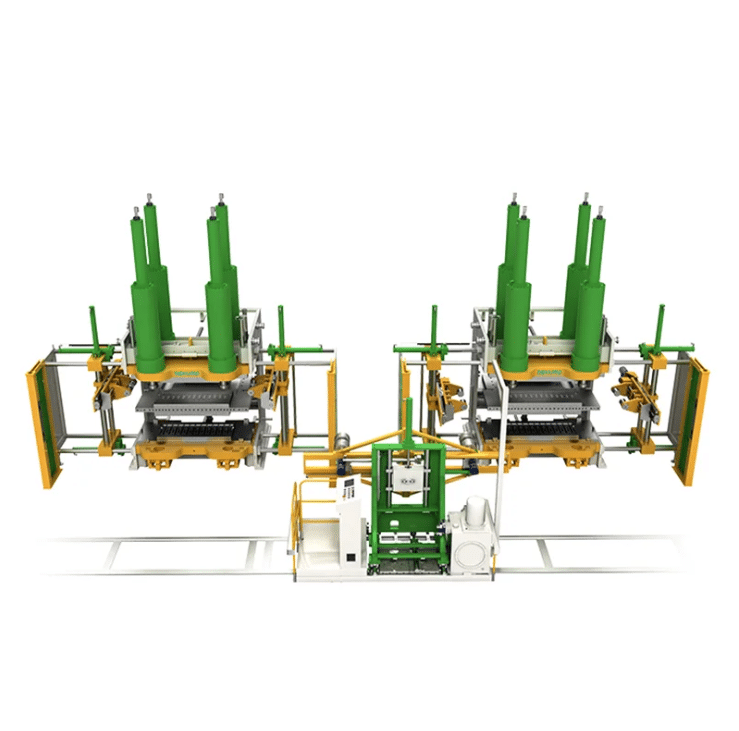
A dedicated rubber track vulcanizing machine can be integrated into a wider production line rather than treated as an isolated press. Automated handling can improve loading consistency, while monitored curing cycles give production teams a clearer view of pressure and timing during each molding cycle.
Dekuma provides rubber track production lines for agricultural, construction, military, and snowmobile tracks. The system combines automated handling, demolding, and process control. Its design includes high automation, smart monitoring, curing shutdown functions, and continuous process iteration.
These functions matter because pressure control depends on more than one machine setting. When handling, curing, and demolding are connected, manufacturers can reduce process gaps between stages. Smart monitoring also gives technicians more information for comparing cycles and identifying conditions that may require adjustment.
What Manufacturers Should Monitor in Daily Production
Daily process control should focus on repeatable conditions rather than one ideal number. Teams can review pressure rise, holding stability, curing duration, temperature response, mould closing condition, and alarm history. A sudden difference may indicate a material, mould, hydraulic, or operating issue.
Maintenance also matters. Seals, hydraulic components, sensors, mould surfaces, and moving parts should be checked according to the production plan. Wear in these areas can influence pressure response or machine movement. Regular inspection makes it easier to separate equipment-related variation from material or process-related variation.
The rubber track manufacturing process can also benefit from comparing production data with finished-part inspection results. If dimensional changes or bonding issues appear, teams can trace them back to specific cycles. This creates a practical link between process records and quality control instead of treating inspection as a separate activity.
For plants producing several track types, recipe management can reduce setting errors. A suitable rubber track vulcanizing machine should allow operators to work with defined process settings for different products. Clear recipes make changeovers easier to manage and support more consistent production when moulds, track sizes, or applications change.
Pressure Control as Part of Long-Term Process Improvement
Pressure control is becoming more important because rubber track production is moving toward better traceability, automation, and repeatability. Manufacturers are not only checking whether a press reaches a target value. They are paying more attention to how pressure behaves throughout the curing cycle and how that behavior relates to product quality.
Equipment suppliers such as Dekuma can support this direction by linking curing equipment with handling, monitoring, demolding, and process management. For manufacturers, the practical goal is to use process data to reduce variation, improve repeatability, and make daily production decisions with stronger technical evidence.